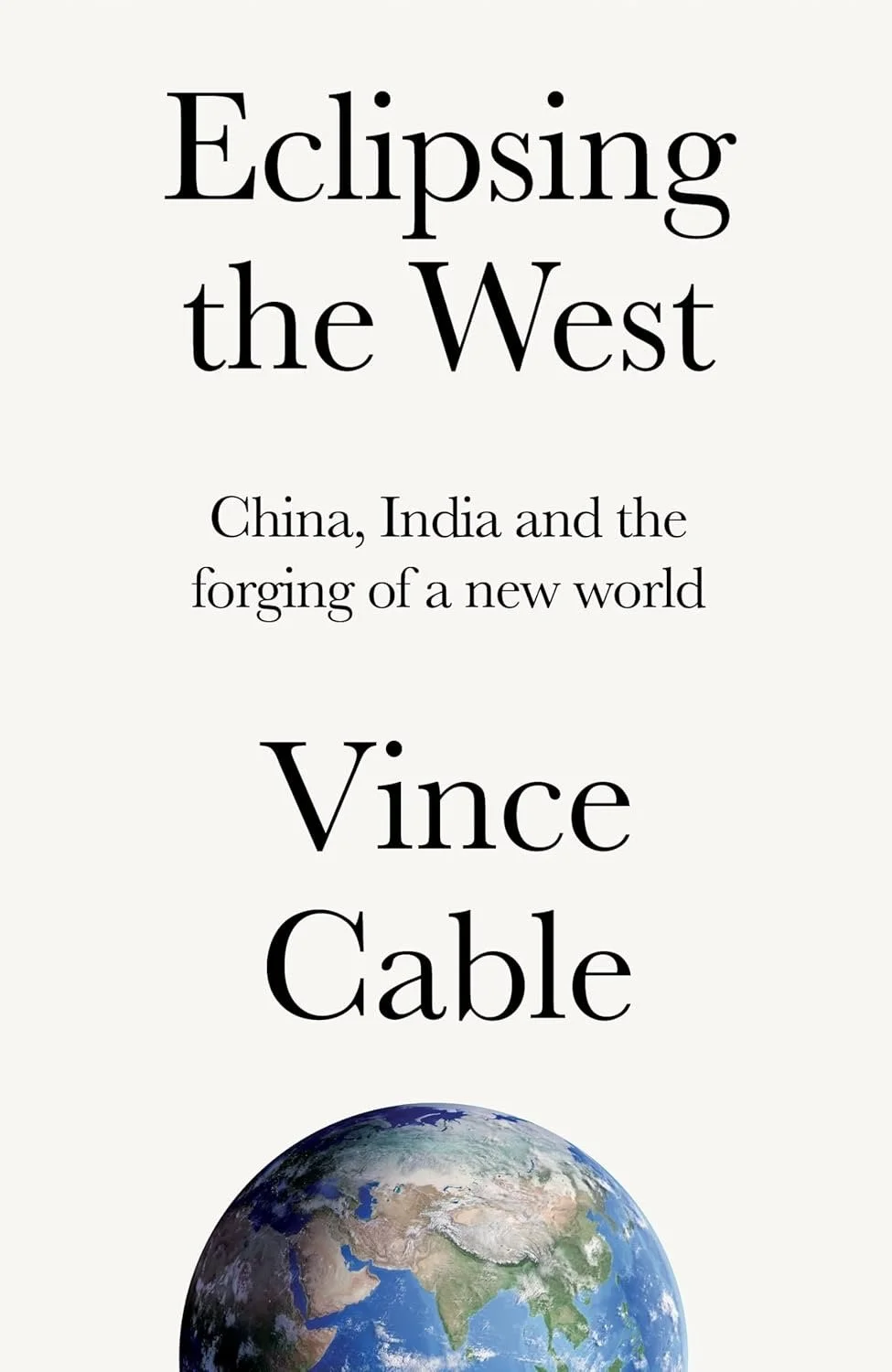
This book argues that the rise of China and India as geopolitical powers is reshaping the international order and that Western dominance is no longer unassailable.
Vince Cable, a long-time economist and former UK government minister, demonstrates how geopolitical dynamics are increasingly driven by economic factors — growth trajectories, trade, investment, and technology leadership — rather than military capability alone.
As the US pulls back from its role as global “enforcer,” underwriting global rules and security guarantees, it leaves space for the Asian superstates to regain the economic shares they held before European imperial expansion in the 1800s.
Cable grounds his argument first in comparative economic data: China’s rise to near‑parity (or better, on some metrics) with the US in total output and trade, and projections that India will reach the number‑two global economic position by mid‑century. He draws on growth trajectories since independence and reform, noting how both states transformed from relatively poor economies with similar per‑capita incomes into very different but increasingly powerful economic models — China in manufacturing and infrastructure, India in services and digitalization.
Second, he points to concrete manifestations of geopolitical and institutional clout:
China’s military modernization and extended reach, and its use of the Belt and Road Initiative to build political and economic influence across Asia, Africa, and Europe.
India’s pursuit of “multi‑alignment,” balancing engagement with Western powers, Russia, and the Global South rather than fitting into Cold War‑style blocs.
He also cites their growing impact on climate negotiations and global energy transitions, arguing that any workable climate regime or trade system now depends on decisions made in Beijing and New Delhi as much as in Washington or Brussels.
Cable’s evidence supports his claim that Western states can no longer unilaterally set rules on trade, technology, or security without accounting for Chinese and Indian preferences and veto points in multilateral forums. Both countries practice forms of state capitalism and assert distinct political values, which means their greater weight will gradually alter norms around sovereignty, development models, and human rights, even if they stop short of seeking global ideological dominance.