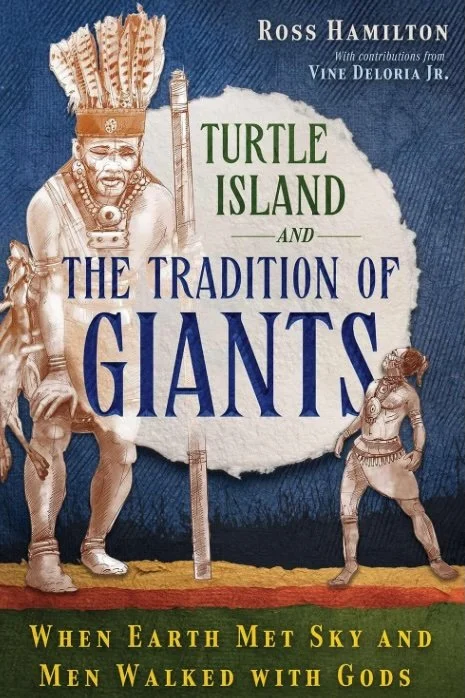
Turtle Island refers to creation teachings of several indigenous peoples — especially Haudenosaunee/Iroquois and Anishinaabe — for the land now commonly called North America, and sometimes for the Earth more broadly.
In these origin stories, the world begins as water. A sky being falls or comes down from the Sky World. Animals help this being and land is formed upon a turtle’s back, often after a muskrat brings pieces of earth from beneath the water.
These stories differ by community and there is no single “Native American” version. But they are all spiritual and ethical: emphasizing reciprocity, humility, cooperation, kinship with animals, and responsibility to the land.
In this book, Ross Hamilton claims that prior to European contact the indigenous peoples of North America interacted with a “race of giants,” including giant bodies in their burial mounds, and allege that institutions like the Smithsonian destroyed or concealed thousands of giant skeletons.
While there is no credible archaeological evidence for an ancient race of giant humans in North America, the folklore of giants is very real and mostly from the past two hundred years. It makes interesting reading, but the “lost civilization” narrative unfortunately implies that indigenous peoples did not build their own mounds, cities, and societies.