One of the greatest explorers in American history, Captain Meriwether Lewis of the1803-6 Corps of Discovery, lies buried in a remote corner of Tennessee where an inn called Grinder's Stand once stood along the old Natchez Trace trail.
It was here, just three years after his triumphant return from the Northwest and his appointment as governor of the Louisiana Territory, that Lewis died under mysterious circumstances. A rectangle of rocks marks the site of a log cabin in which Lewis spent his final hours and a short path leads to his gravesite and monument. A preserved stretch of the Natchez Trace that Lewis was traveling before his death passes by the monument and is now frequented by day hikers and visitors to the Meriwether Lewis Monument.
"As you walk the Trace, consider how American history might have changed had Lewis walked the path you are on now, instead of having his journey cut short at Grinder's Stand," writes Johnny Molloy in his guidebook, "60 Hikes Within 60 Miles: Nashville." (Menasha Ridge Press, 2003).
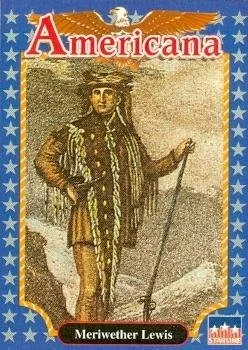
Meriwether Lewis, Explorer #22 - 1992 Americana Trading Card
"Considering his fame and popularity after his Corps of Discovery mission to the Pacific, he might have become
President. The Meriwether Lewis Monument, a shaft extending skyward, is broken off at the top, symbolizing a life of potential greatness cut short for reasons unknown."
The 35-year-old Lewis arrived at Grinder's Stand on the afternoon of Oct. 10, 1809, en route to Washington, D.C. to clear up the issue of some unpaid debts to the War Department. A close friend and personal secretary to President Thomas Jefferson, Lewis found himself cornered by bureaucratic opponents once Jefferson left office and a new administration took power.
War with Britain was also on the horizon and political enemies were hiding behind every corner. Lewis traveled into Tennessee with his personal servant, a government Indian agent named James Neelly and a number of Chickasaw Indians. When two of the party's horses were lost, Neelly and the Chickasaw stayed behind to hunt for them while Lewis traveled on to Grinder's Stand. The innkeeper was away at the time, but his wife gave Lewis accommodations and prepared his dinner.
The official story on his death is that Lewis was acting strangely during the trip and may have attempted suicide on previous occasions. He succeeded at Grinder's Stand, shooting himself in the head and chest and died the next day after hours of agony. The innkeeper's wife told Neelly what happened when he arrived and he passed the word along to Jefferson.
Not everyone is satisfied with that account, however. Some in Lewis' family believed an unfaithful free servant played a role in his demise. Others point an accusing finger at political enemies, Neelly, the innkeeper Robert Grinder, the innkeeper's wife Priscilla, and a local land pirate, Tom Runion. Lewis' watch reportedly turned up in a pawn shop in New Orleans years after his death.
In 1962 Idaho writer Vardis Fisher published a thoroughly researched book titled, "Suicide or Murder?: The Strange Death of Governor Meriwether Lewis" in which he questioned Lewis' suicide and probed the murderous possibilities. Is it Lewis' body, even, that lies beneath his monument?
Historian Dee Brown quotes one local resident near the Natchez Trace as saying that "everybody knows what happened. Robert Grinder came home that night, found Meriwether Lewis in bed with his wife, and shot him. The rest of the story she just made up."
Whatever the truth of the matter, Lewis' sudden demise was startling at his young age and after all he had
accomplished. Syphillis contracted from Indians he camped with during the Corps of Discovery expedition may have driven him to madness, or perhaps he was drinking too heavily or made one too many enemies. Like a stain on the carpet, this mystery out of the past lingers and begs for answers not forthcoming.
Michael Hofferber. Copyright _ 2003. All rights reserved.