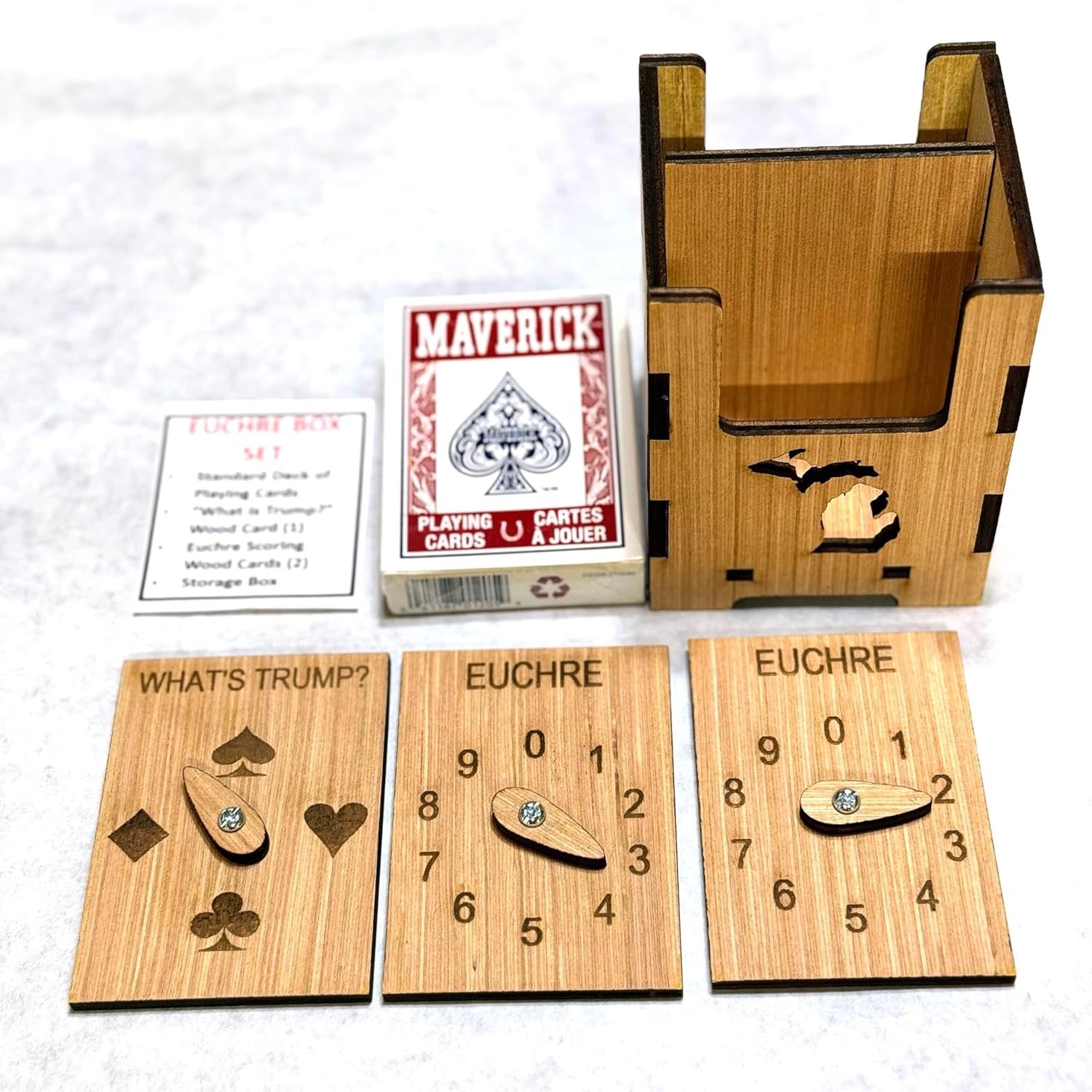
Euchre is a classic trick-taking card game, typically played by four people in two partnerships, with partners sitting opposite each other. The game uses a special deck of 24 or 25 cards with just the 9, 10, Jack, Queen, King, and Ace of each suit. Sometimes a joker is included.
Euchre originated in Alsace, France, in the early 19th century, where it was called “Juckerspiel.” German-speaking immigrants brought it to North America, where it became especially popular in the Midwest and Ontario. In the late 19th century it was considered the national card game of the USA.
No special boards or chips are required for play, although some players have custom-made scoreboards and storage boxes for their cards. Most use a regular deck of playing cards with the unnecessary cards removed. Scorekeeping is usually done with pencil and paper, or “counter cards”or score cards.
Euchre has evolved significantly since its origins in Europe. Early versions used larger decks and different scoring. The Joker was introduced to modern card decks in the 1850s, originally used as the highest trump card — a role it still holds in some British versions, though most American versions now play without it.
Over time, Euchre developed many regional variations, such as "Bid Euchre," "Cutthroat Euchre," and rules like "Stick the Dealer" or "Going Alone," reflecting local preferences. The game’s popularity declined with the rise of games like Bridge and Spades, but it remains a beloved social pastime in specific regions and has adapted to digital play in the modern era.
The winner in Euchre is the first team to reach the target score, usually 10 points.