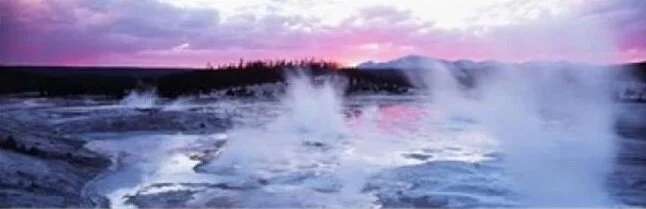
Colter's Hell is a mostly inactive geyser district located just west of Cody, Wyoming, at the mouth of the Stinkingwater River Canyon.
While geyser activity has been minimal in recent times, there are accounts of geothermal activity similar to that inside the boundaries of Yellowstone National Park in the not too distant past.
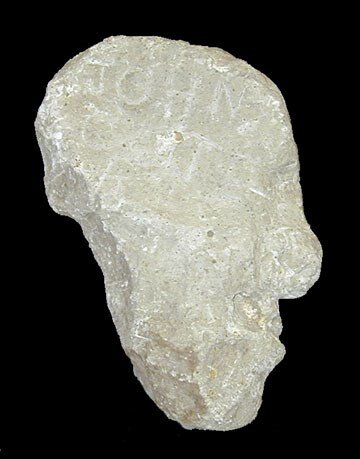
The head-shaped Colter Stone, which may have been carved by the famous mountain man, was discovered near Tetonia, Idaho, in 1931. One side reads, "John Colter," the other, "1808." The stone was found by a farmer plowing his field; he traded it for a pair of boots.
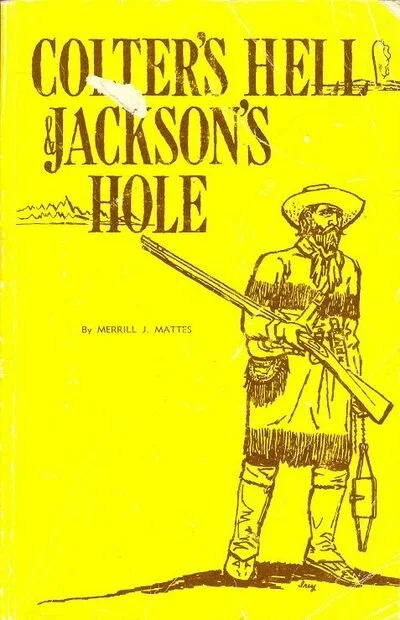
John Colter, an intrepid member of the Lewis and Clark Expedition, gave the first accounts of the area to non-native Americans following his solo journey of 1807-1808. But Colter's descriptions of gloomy terrors, hidden fires, smoking pits, noxious streams and the all-pervading smell of brimstone were too wild for his listeners to believe. They derisively dubbed the imaginary place "Colter's Hell."
It wasn't until Thomas Moran painted the natural features of Yellowstone National Park and William Jackson brought back photographs in 1871 that the American public realized that Colter's accounts were no fantasy.
"While the true Colter's Hell was outside of Cody, it was also erroneously associated with an active geothermal area in the northwestern section of Yellowstone National Park," Michael Rutter points out in Myths and Mysteries of the Old West.
"Hiriam M. Chittenden perpetuated the false mythology in his book titled Yellowstone National Park. He called the Geyser Basin Colter's Hell. This was an honest error on his part, but the name caught on. For more than a hundred years now, folks have equated Geyser Basin with with John Colter. While he traveled a great deal, Colter never actually made it to that sulfurous section of Yellowstone National Park. Chittenden corrected the error, incidentally, in his next book, a book worth reading, called The American Fur Trade of the Far West. Colter's place in folklore had already been sealed however, and the legend continues to this day."